Ghost
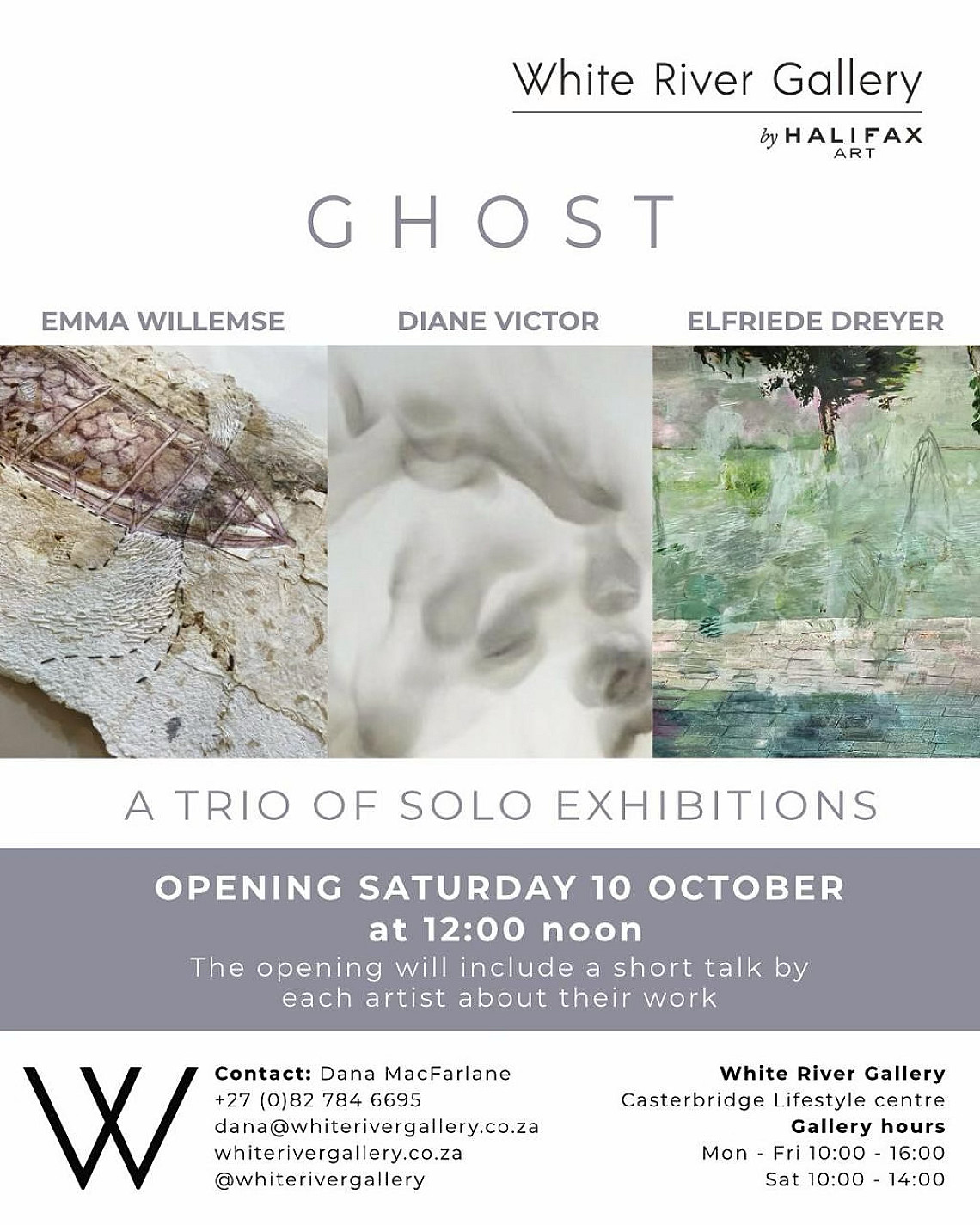
October 10, 2026 - November 30, 2026
White River Gallery
GHOST
A trio of solo exhibitions
Emma Willemse, Elfriede Dreyer, Diane Victor

|
|
|


Opening speech by Emma Willemse
Good day everyone. I am honored to exhibit at this beautiful gallery. Thank you to Dana and the gallery team for hosting the exhibition and for all the support with the installation setup. I am also honored to exhibit with two amazing artists. Elfriede, thank you for inviting me. It is wonderful to exhibit with you, Diane.
I want to share with you an experience.
When I was a small girl, my father and I used to take long walks in the veld and hills adjacent to home where we lived. One day, after a long walk, we discovered a ruin. The moment I stepped over the entrance threshold, it felt to me as if I am stepping onto holy ground. I remember that it smelt differently inside than in the veld, but to this day I cannot describe the smell. I do remember, though, that the smell reminded me of water.
Fast forward about 35 years later and I am stepping over the threshold of the shell of a house that I used to live in. I knew that the house was going to be demolished - my friend, Else du Plessis, called me the previous day to say that today is the last day before the bulldozers will move in and knock all the walls down.
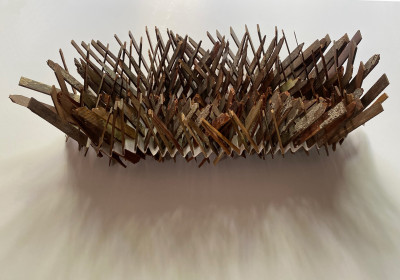
When I entered my previous home, I realized that the demolishment had already started, because everything that was of value was ripped out: the wooden rafters, the pipes, the tiles and the wooden parquet floor blocks. There were heaps of parquet floor blocks in every room. On the spur of the moment, I took some of these blocks with me in plastic bags. Much later, this act sparked many artworks. I made boats, suspended installations, wall installations and artist’s books with parquet floor blocks.
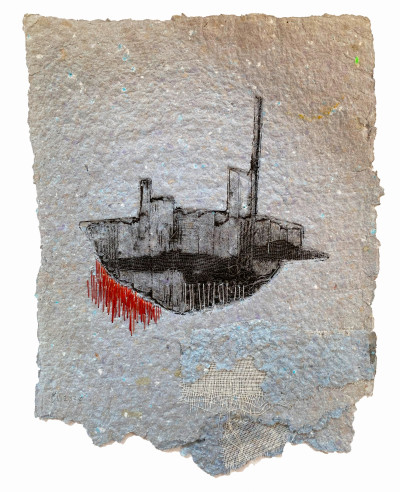
In this show I am exhibiting Apparition, which is both a boat and an artist’s book. It is made entirely from discarded parquet floor blocks shards found in Woodstock, Cape Town, where a gentrification process is causing displacement.
I discovered the writing of the philosopher Laura U Marks during my research on the phenomenon of displacement. She wrote the book The Skin of the Film, in which she maintains that objects “are not inert and mute but they tell stories and describe trajectories” (2000:120). Marks assigns an animated role to objects in which their meaning and significance reside in their physicality, their materiality and their tactility, in the same way “as habit stores memory in the body” (2000:121). I fully agree with this, yet my research on objects goes much further. To unpack the meanings of objects, I am also interested in their origin, why and how they were manufactured, their function and what role did they play in people’s lives. I am interested in the history and memory of found objects.
For instance, the paint shards that I use in the works Reclaimed Archive II and Mapping the Aftermath, originate from the wall of a friend’s home. When she moved into the house, she wanted to repaint the wall and then discovered that the existing paint peels off in big sheets, almost like skin, revealing layers of history of how the previous owners decorated their home.
The big boat-like installation, called The Wake, is constructed from a makoro, a dugout canoe usually found in Africa near waterways, such as the Okavango Delta and Mozambique. The oldest makoro was found buried in Nigeria. After it was excavated, it was carbon dated as 9000 years old, which means that even at that early stage a culture existed of traversing waterways to fish, to visit other people, to trade. In The Wake, my intention is to honour this forgotten and gentler way of life with a drawing of the decayed canoe, done with paper pulp on scrim fabric. The drawing is suspended above the canoe, as if its spirit is leaving its body.
The way that I use materials is central to the thematic concern of the Ghost exhibition. This is what I do: I use and transform found remnants of places and objects that were previously ‘living’ – which means that they were formerly in use as part of everyday life but are now discarded or forgotten. Nevertheless, as traces or vestiges of those things that disappeared or no longer exist; these objects still have agency and they still impart an energy. They are nodes that connect us to history, that infuse in us fleeting memory traces of events of the past, reminders that revisit us like transient apparitions.
Marks, L.U. 2000. The skin of the film: intercultural cinema, embodiment, and the
senses. Durham: Duke University Press.